As artificial intelligence continues to reshape industries, millions of workers worry that machines will take over human jobs. While AI is powerful, it cannot replace emotional intelligence, creativity, ethical decision-making, and human connection.
In reality, some jobs become more valuable in the AI era.
Here are the top careers AI will NOT replace — and the reasons why these roles remain safe in the future.
1. Teachers & Educators
AI can provide information, but it cannot replace human understanding, empathy, and mentoring.
Teachers inspire students, guide learning, and build emotional connections — something machines can’t replicate.
AI-proof skills:
- Empathy
- Communication
- Personalized teaching
2. Psychologists, Counselors & Therapists
Mental health requires deep emotional support.
AI cannot fully understand trauma, human pain, or complex emotions.
Why AI can’t replace this job:
People need humans to feel heard, understood, and safe.
3. Doctors & Medical Professionals
AI helps doctors diagnose faster, but it cannot:
- Perform complex surgeries independently
- Comfort patients emotionally
- Make ethical decisions
Human judgment is essential.
4. Creative Artists (Writers, Musicians, Designers)
AI can assist in creativity, but it cannot create:
- Original lived experiences
- Emotional storytelling
- Cultural sensitivity
Human creativity remains irreplaceable.
5. Lawyers & Legal Experts
AI can analyze documents, but legal practice requires:
- Interpretation
- Negotiation
- Advocacy
- Ethical reasoning
Courts and clients need human judgment.
6. Social Workers
Social workers navigate human crises:
family issues, societal challenges, abuse cases, and emotional trauma.
AI cannot build trust or intervene in sensitive human situations.
7. Skilled Trades (Electricians, Plumbers, Mechanics)
These jobs require hands-on work, problem-solving in unpredictable environments, and physical presence.
AI and robots cannot fully perform complex real-world repairs.
8. Entrepreneurs & Business Leaders
Leadership requires:
- Innovation
- Risk-taking
- Vision
- Human motivation
AI can help leaders, but cannot be one.
9. Research Scientists
AI can process data, but human curiosity drives scientific discovery.
Scientists propose new theories, challenge norms, and explore unknown questions.
10. Human Resource Managers
Hiring is not only about skills — it’s about personality, culture fit, and potential.
Humans make better decisions in understanding people.
11. Caregivers & Nurses
Elderly care, baby care, and patient care require compassion, physical presence, and trust.
AI cannot comfort or emotionally support patients.
12. Sales & Marketing Professionals
AI can generate ads, but humans understand:
- Customer behavior
- Emotions
- Culture
- Relationship building
High-level sales is built on human interaction.
13. Chefs & Culinary Experts
AI can give recipes, but cooking requires:
- Creativity
- Taste
- Experience
- Cultural influence
Human chefs create unique food experiences.
What Skills Will Be Most Valuable in the AI Era?
To stay future-proof, focus on skills AI cannot copy:
Human Skills:
- Creativity
- Critical thinking
- Emotional intelligence
- Leadership
Technical Skills:
- AI literacy
- Problem-solving
- Cybersecurity
- Digital communication
Hybrid Skills:
A mix of soft skills + tech skills will make you unstoppable.
🎯 Conclusion: AI Will Change Jobs, Not Replace Humans
AI is powerful, but it lacks human emotion, ethics, creativity, and presence.
Many careers will transform — not disappear.
Workers who adapt, learn AI skills, and focus on human strengths will thrive in the future.
14. Athletes & Sports Professionals
Sports involve human performance, teamwork, excitement, and emotional storytelling.
AI can’t replace athletes, coaches, or trainers.
15. Emergency Responders (Firefighters, Police, Paramedics)
These jobs require quick decisions in dangerous, unpredictable situations.
AI cannot replace courage, intuition, or rapid human judge.
Jobs With the Lowest Risk of Automation by AI
According to the U.S. Career Institute, the following jobs are the least impacted by the introduction of AI. These jobs have a very low job automation risk probability, due to the abilities, knowledge, skills, and activities required to perform these jobs successfully.
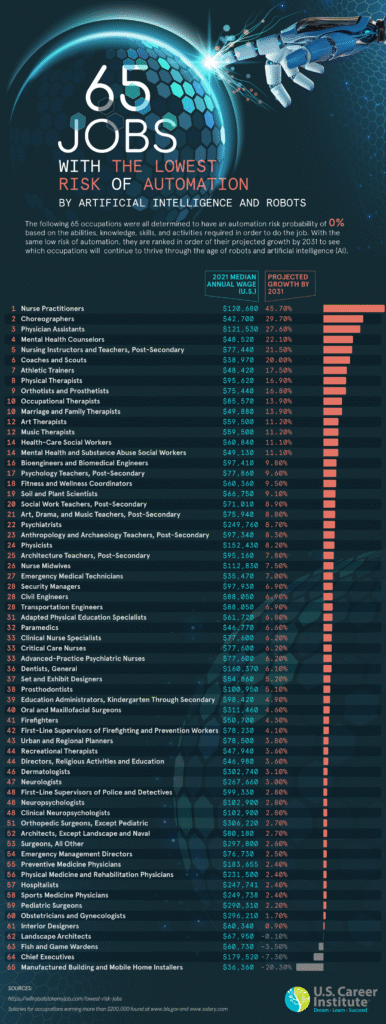
Source: US Career Institute