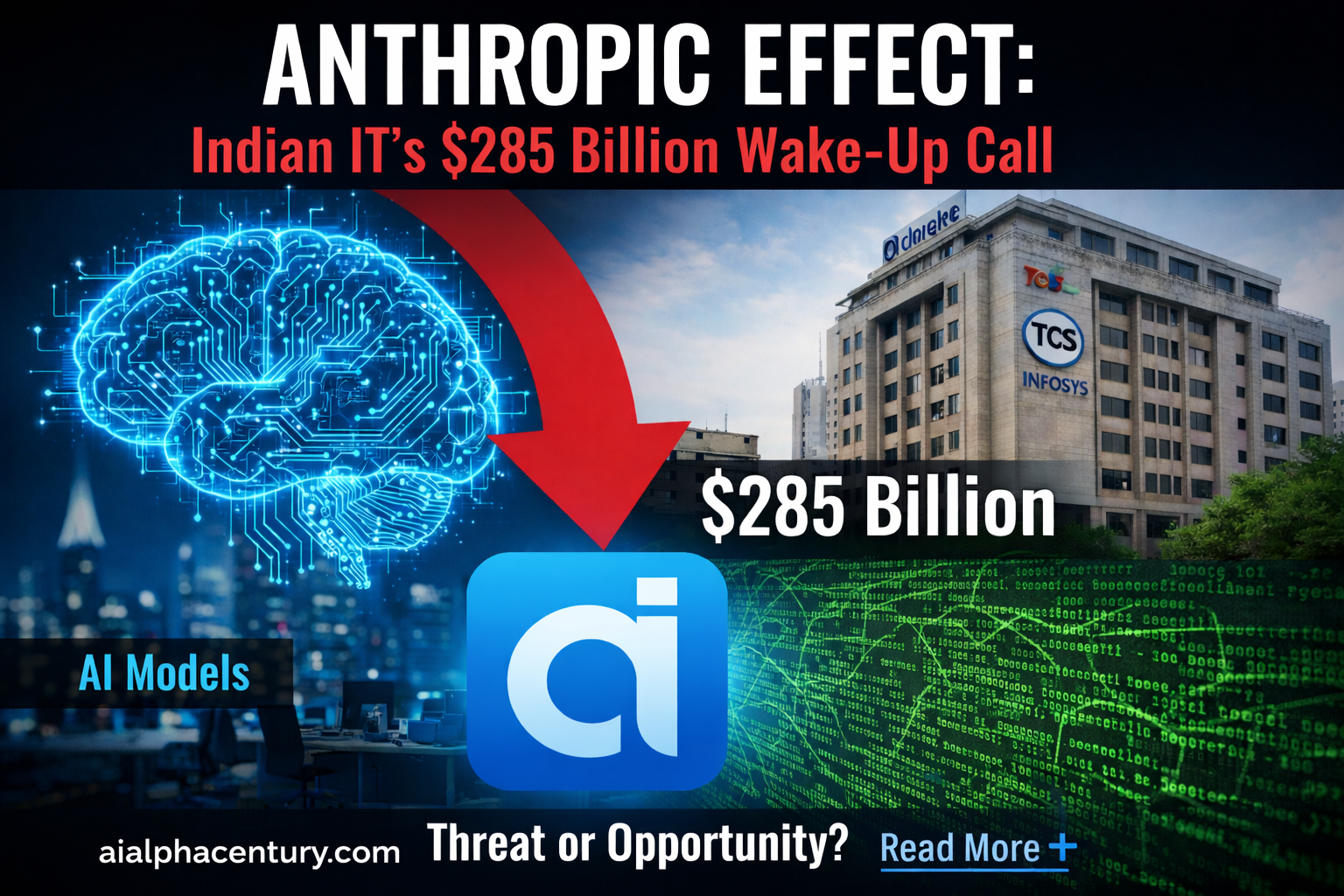
The global tech landscape just felt a seismic shift. When Anthropic AI announced its latest B2B-focused cloud models and specialized plugins, the ripples weren’t just felt in Silicon Valley—they crashed directly into Dalal Street. With a staggering $285 billion wiped off global markets and the Nifty IT index sliding 5-6%, the industry is asking: Is this the beginning of the “SaaS Apocalypse”?
What Exactly is the ‘Anthropic Effect’?
The term ‘Anthropic Effect’ describes how advancements in AI technologies, like those introduced by Anthropic, can lead to significant shifts in societal and economic landscapes, particularly in understanding the implications of the Anthropic Effect on various industries.
While OpenAI captured the world’s imagination with conversational AI, Anthropic is going after the world’s ledger books, a move that exemplifies the potential of the Anthropic Effect.
The concept of the Anthropic Effect is gaining traction in various discussions around AI and its implications.
They’ve introduced a suite of AI plugins specifically designed for high-stakes industries like BFSI (Banking, Financial Services, and Insurance) and Legal Services. Unlike general chatbots, these models are built to handle:
- Complex Contract Reviews: Digging through thousands of pages of legal jargon.
- Fraud Detection: Identifying patterns in unstructured financial data in real-time.
- Automated Sales Execution: Managing entire campaigns without human intervention.
By connecting AI directly to business software, Anthropic has moved from “answering questions” to “executing workflows.”
The Threat: Why Indian IT Giants Are Shaking
For decades, the bread and butter of Indian IT firms like TCS, Infosys, and Wipro has been manual intervention—migration, maintenance, and junior-level coding. Anthropic’s model hits exactly where it hurts:
- The 70% Rule: It is estimated that these new AI agents can automate up to 70% of routine coding and data entry. This puts junior-level roles at immediate risk.
- The End of Manual Migrations: Traditional SAP and Oracle migrations, which used to take thousands of man-hours, are now being eaten by automated AI plugins.
- Revenue Pressure: Analysts predict a potential 9-12% revenue hit for traditional IT services over the next few years as clients opt for automated SaaS solutions over human-managed services.
The Silver Lining: The Great COBOL Rescue
It’s not all doom and gloom. As the saying goes, “In the middle of difficulty lies opportunity.” For Indian IT, that opportunity is hidden in 60-year-old code.
Much of the world’s financial infrastructure still runs on COBOL. These legacy systems are incompatible with modern AI. With 68% of COBOL developers retiring by 2025, there is a massive talent vacuum.
Mid-cap players like Mphasis are already pivoting. They aren’t just “fixing” code; they are using AI to:
- Extract business logic from ancient systems.
- Rewrite architectures into Java or HTML.
- Modernize data centers to handle real-time AI processing.
The Reality Check: While AI writes the code, humans are still needed “in the loop” to ensure compliance and architectural integrity. The job isn’t disappearing; it’s evolving from “builder” to “architect.”
Mapping the AI Stack: Where Does India Stand?
To understand the future, we have to look at the five layers of the AI economy:
The Verdict: India is a powerhouse in the “Physical” and “Application” layers. However, to remain sustainable, the sector must move beyond just using US models and start developing proprietary, sovereign AI capabilities.
| Layer | Function | Indian IT Presence |
| Energy | Cooling & Power | Strong (TCS & Data Center investments) |
| Infrastructure | Physical Data Centers | Growing (Significant CapEx) |
| Compute | Chips & Cloud Power | Moderate (Reliance on NVIDIA/US Tech) |
| AI Models | Core LLMs (Anthropic/OpenAI) | Weak (Mostly US-driven) |
| Applications | Front-end Business Tools | Dominant (Implementation & Customization) |
Final Outlook: Adapt or Evaporate
The “Anthropic Effect” isn’t a death knell; it’s an accelerant. The market’s 7% drop was a visceral reaction to the fear of the unknown, but the fundamental strength of Indian IT—its domain expertise in BFSI and its massive infrastructure—remains intact.
The winners of 2026 won’t be the companies with the most employees; they will be the companies with the smartest Human-AI collaboration models.