What if your phone didn’t have apps?
That’s the radical idea behind the rumored OpenAI AI smartphone, a project linked to legendary designer Jony Ive and OpenAI CEO Sam Altman.
Instead of tapping through apps, scrolling endlessly, and managing dozens of interfaces, this device could let you simply talk—and everything gets done.
It sounds futuristic. But it might be closer than we think.
What Is the OpenAI AI Smartphone?
The OpenAI AI smartphone is a rumored next-generation device built around artificial intelligence as the core interface—not apps, not touchscreens.
Unlike traditional phones from Apple Inc. or Samsung Electronics, this device is expected to:
- Replace apps with AI agents
- Understand context (location, habits, intent)
- Act proactively instead of reactively
- Offer a conversational interface
👉 In simple terms:
It’s not a smarter phone—it’s a completely different way of computing.
The Jony Ive Factor: Why This Device Matters
Jony Ive isn’t just any designer—he helped create the iPhone, iPad, and modern Apple design language
His involvement signals something important:
- A focus on minimalism and simplicity
- Hardware and software designed together
- A product that feels intuitive, not technical
This isn’t about adding features. It’s about removing complexity.
AI Agents Instead of Apps: The Biggest Shift
Here’s where things get disruptive.
Today:
- You open apps
- You switch between them
- You manage tasks manually
With OpenAI’s vision:
- You ask once
- The AI handles everything
Example:
- “Book me a cab and text Rahul I’m on the way”
- “Summarize my emails and reply to urgent ones”
No apps. No switching. No friction.
This is called an agent-first ecosystem, and it could make current smartphones feel outdated overnight.
Is It Really a Smartphone?
Not exactly—at least not in the traditional sense.
There are actually two parallel ideas:
1. The Jony Ive AI Device (First Release)
- Possibly screenless or minimal display
- Pocket-sized or wearable
- Voice-first interaction
- Designed as a daily AI companion
2. The OpenAI Smartphone (Later Release)
- More familiar form factor
- Deep AI integration
- Could compete with iPhone and Android
👉 Translation:
The first product may replace how you use your phone, not replace the phone itself—yet.
⚙️ Expected Features (Based on Leaks & Industry Signals)
🧠 1. AI-First Operating System
A completely new OS built around intelligence—not icons.
⚡ 2. Custom AI Chips
Likely partnerships with chipmakers to handle:
- On-device AI processing
- Faster responses
- Better privacy
🌍 3. Context Awareness
The device may understand:
- Your schedule
- Your location
- Your habits
And act before you even ask.
🎙️ 4. Always-On Assistant
Think Siri—but actually useful:
- Continuous listening (with privacy controls)
- Real-time responses
- Deep personalization
⚠️ Challenges: Why This Could Fail
Let’s not ignore reality—this is extremely ambitious.
🔐 Privacy Concerns
An always-listening AI raises serious questions:
- Data collection
- Security risks
- Trust issues
🧠 Behavior Change
People are We got used to it to apps and screens.
Switching to AI-first interaction is a massive habit shift.
🏆 Competition
Tech giants like:
- Apple Inc.
- Samsung Electronics
…are already integrating AI into existing ecosystems.
📅 Expected Release Date
While nothing is officially confirmed:
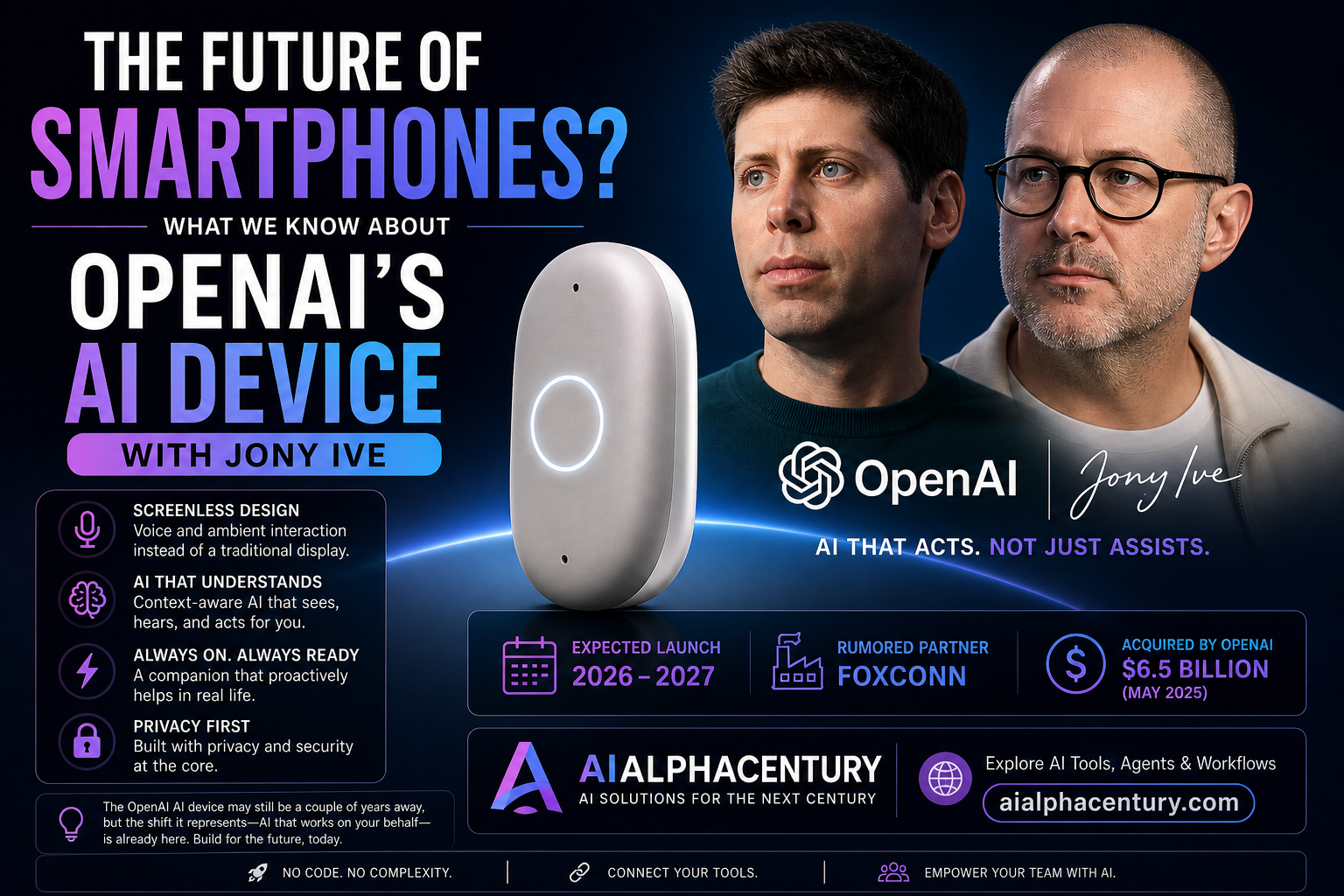
- First AI device: 2026–2027
- OpenAI smartphone: Around 2028
These timelines are based on industry leaks and analyst predictions.
🔮 Why This Could Be the “Next iPhone Moment”
When the iPhone launched in 2007, it didn’t just improve phones—it changed behavior.
This device could do the same by:
- Eliminating apps
- Replacing touch with conversation
- Turning AI into your primary interface
👉 If successful, it won’t compete with phones.
It will replace the concept of phones.
🧾 Final Thoughts
The OpenAI AI smartphone—and the broader Jony Ive device ecosystem—isn’t just another tech rumor.
It represents a bigger shift:
From tools we use → to systems that act for us
Whether it succeeds or fails, one thing is clear:
The future of smartphones will be AI-first.
Key Takeaways
- In May 2025, OpenAI acquired io Products for approximately $6.5 billion, bringing legendary designer Jony Ive directly into its AI hardware ambitions.
- The first device is expected to break away from traditional smartphones, potentially featuring little to no screen and relying instead on voice, context, and ambient intelligence as the primary interface.
- Strategically, OpenAI is aiming to control the entire AI stack—from hardware to software to models—rather than operating within ecosystems dominated by Apple Inc. or Google.
- Current reports point to a 2026–2027 launch window, with Foxconn emerging as a likely manufacturing partner.
- For enterprises, the implications are substantial: always-on AI systems capable of taking real-world actions will require deep integration with existing business workflows and tools.
- Platforms like MindStudio already enable this shift—allowing organizations to build AI agents connected to their systems, deployable across interfaces, and usable without coding.
- While the OpenAI device itself may still be a few years away, the broader transition it represents is already in motion:
moving from AI as a tool you use to AI as a system that works on your behalf. Organizations that begin building for this paradigm today will be better positioned for what comes next.
Tired of switching between apps? This video reveals a future where AI does everything for you.