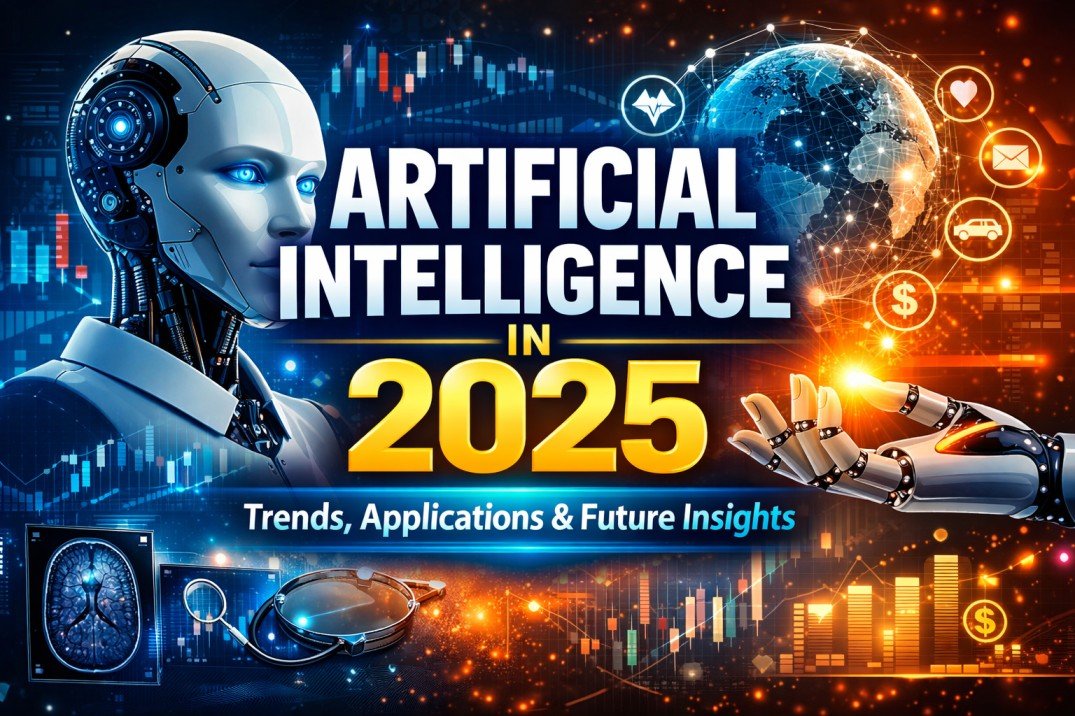
Welcome to our blog, where we explore the fascinating and rapidly evolving world of Artificial Intelligence (AI) and the AI Revolution. Whether you’re a seasoned tech enthusiast, a curious newcomer, or somewhere in between, we’re excited to embark on this journey with you. In this post, we’ll provide a comprehensive and up-to-date overview of how AI has evolved, how it is being used today, and what the future holds for society.
Rethinking AI in 2025: Beyond Science Fiction
The AI Revolution: Transforming Our Future
For many, the phrase “Artificial Intelligence” conjures images of futuristic robots and sentient machines from science fiction. While those ideas capture the imagination, the reality of AI in 2025 is far more nuanced—and profoundly impactful. Today, AI is integrated into our lives in ways most of us take for granted, from the apps on our phones to critical decision systems in business, healthcare, and education.
At its core, Artificial Intelligence is the science of creating machines and computer programs capable of performing tasks that typically require human intelligence. These systems use statistical learning, pattern recognition, logic, and data processing to make decisions, analyze environments, and support outcomes that would otherwise depend on human effort or intuition. McKinsey & Company
What AI Can Do: Core Capabilities
Modern AI systems excel in several key functions:
- Learning: AI systems can improve their performance over time by processing more data and refining patterns.
- Reasoning: Using logic and predictive models, AI can draw conclusions and support decision-making at scale.
- Problem-Solving: Complex challenges, from medical diagnosis to supply chain optimization, are now addressed with AI-assisted approaches.
- Perception: AI can interpret sensory data such as images, sound, and video to understand environments.
- Language Understanding and Generation: Powerful language models comprehend and generate text, enabling chatbots and assistants to interact naturally with users. McKinsey & Company
These capabilities are not just technical terms—they underpin systems you interact with every day.
AI in Everyday Life
You might be surprised how deeply AI is woven into our daily experiences:
- Entertainment: Recommendation engines analyze your viewing habits to suggest movies, shows, and music you may enjoy.
- Smart Devices: Voice-controlled assistants and intelligent mobile features respond to spoken commands with increasing accuracy.
- Search Engines: AI algorithms tailor results to your interests and context.
- Security: Real-time, AI-based fraud detection helps protect online payments and sensitive data.
- Healthcare: AI tools are enhancing imaging analysis—sometimes achieving diagnostic accuracy comparable to expert clinicians. Stanford HAI
New Developments Shaping AI in 2025
AI is not static; it continues to advance at an extraordinary pace. Some of the most notable developments in 2025 include:
- Agentic AI and Autonomous Agents: Systems that go beyond responding to instructions to act independently in complex workflows are gaining traction, especially in business and automation. The Times of India
- Advanced Large Language Models: Companies such as Google DeepMind have released models (e.g., Gemini 3) that improve reasoning, factuality, and multilingual understanding. blog.google
- Multimodal AI Systems: AI models can now interpret and combine data from text, images, video, and speech to make decisions that reflect real-world complexity. Coursera
- Voice-First AI Assistants: Voice-powered AI is becoming more responsive and context-aware, potentially reshaping how we interact with technology without screens. Reuters
- AI in Emerging Economies: Initiatives like India’s homegrown AI apps showcase efforts to democratize AI development and position local innovations on the global stage. The Economic Times
- Integration with Sustainability: AI is being applied to energy systems and climate efforts, such as optimizing renewable grids and reducing waste. Reuters
AI Across Industries
Today, AI is not just a tool for tech companies—it is reshaping sectors worldwide:
- Healthcare: From emergency medicine and diagnostics to personalized treatment suggestions, AI is reducing costs and improving outcomes. News-Medical
- Finance: Banks and financial institutions use AI for real-time risk assessment and fraud prevention. The Australian
- Education: AI literacy initiatives are emerging in school systems to prepare the next generation for a tech-driven future. The Times of India
- Manufacturing and Logistics: Autonomous agents and predictive models increase productivity and reliability. Wappnet Systems Pvt. Ltd.
What We’ll Cover in This Blog
In future posts, we’ll explore each of the following topics in detail:
- Fundamental Concepts and Terminology: Understanding the core ideas and jargon so you can follow with confidence.
- Branches of AI: From machine learning and deep learning to natural language processing and computer vision.
- Real-World Applications: Sector-specific insights showing how AI is transforming industries.
- Ethical Considerations: Critical discussions about privacy, bias, transparency, and human-centric AI. Dataversity
- The Future of AI: A forward-looking view of where the technology is headed—and how it might reshape society.
Our Commitment to You
Our goal is to provide insightful, accessible, and engaging content that helps you understand both the power and limitations of AI. We will explore not just what AI can do, but what it should do, and how societies can shape its development responsibly.
We invite you to participate: share your thoughts, questions, and experiences in the comments below. Let’s build a community of learners and explorers passionate about technology’s future.
What are your initial questions about AI? Join the conversation and let’s explore together.